Nuclear fission
The first thing to sort out before we begin discussing nuclear fission is
binding energy.
The definition of binding energy is not hard to find:
The binding energy of a nucleus is the minimum energy needed to split the nucleus into
its constituent nucleons
(protons and neutrons). A nucleus is a system of bound nucleons,
consisting of Z protons (the mass of a proton in the free state is mp) and N neutrons (the mass
of a neutron in the free state is mn). In order to split a nucleus into its constituent nucleons, one must
spend
a certain minimum energy W, called the binding energy. In doing so a nucleus at rest with
mass M turns into a set of free protons and neutrons at rest with a total mass
Zmp + Nmn.
The energy of the nucleus at rest is Mc2. The energy of the released nucleons at rest is (Zmp + Nmn)c
2.
In accordance with the law of conservation of energy, Mc
2+W=(Zmp + Nmn)c2. Or W=(Zmp + Nmn)c
2 - Mc
2.
Since W<0, then M< (Zmp+Nmn), i.e. the mass of the initial nucleus, in
which the nucleons are bound, is less than
the sum of the masses of the free nucleons that make it up.
W grows with the increase of the number A of nucleons in the nucleus
(A = Z + N). It is convenient to work with the specific binding energy = W/A, i.e.
the average binding energy per
nucleon. For most nuclei it is 8 MeV
(1 MeV = 1.6.10-13 J). Breaking a chemical bond needs
an energy 106 times smaller.
Let us try to look at binding energy from another side.
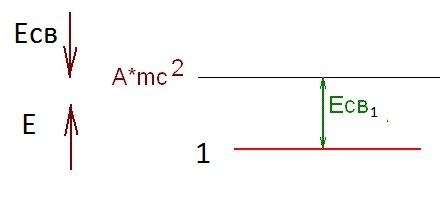
Suppose that A nucleons have the energy E0 = A*m*c^2, where m is the mass of a nucleon
(for now we will not
distinguish between protons and neutrons). These A nucleons are not
bound to one another, i.e. E_b_0 = 0.
Now suppose that these A nucleons have formed a nucleus, and a nucleus is a bound system,
E_b_nuc is not equal to 0.
What does this mean?
The nucleons have lost part of their energy by becoming bound. Numerically, the energy they
have lost is equal to the energy that will be required to break this system apart (see the definition).
Why do nucleons lose energy?
In the free state the motions of nucleons are not restricted by anything (except that the Coulomb force
acts on protons), in the
bound state, however, not every motion is possible, so one can say
that part of the energy has been spent on binding
the nucleons into a system.
Since the nucleons have lost energy, it means it has been released somewhere.
In the case when two protons fuse
1H + 1H = 2H + e+ + ve
a positron and a neutrino are emitted, apparently all the energy is transferred to them -
(it can also be transferred to the
kinetic energy of 2H) meaning the excess energy.
Graphically this can be depicted as follows
Let us find out what can happen to nucleus 1 next.
It is known that if one divides the total binding energy of various nuclei by the number of nucleons
in these nuclei, the resulting values will differ.
E_b1/A1 is not equal to E_b2/A2
That is, the specific binding energy per nucleon depends on A.
The shape of the dependence is approximately as follows.
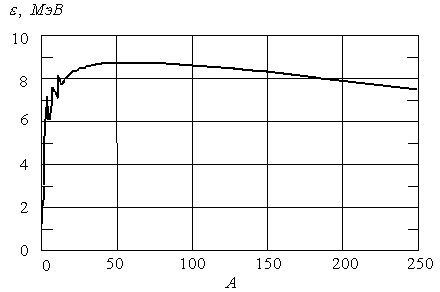
On average the binding energy is 8 MeV
per nucleon, but there are regions where nuclei
are bound more strongly.
What are these regions?
When the number of nucleons of one type in a nucleus equals a magic number
(2, 8, 20, 28, 50, 82, 126), for example a He nucleus has 2 protons and 2 neutrons,
a Pb nucleus has 82 protons. The binding energy increases noticeably, this
is connected with various orbital effects.
Thus some states are bound more strongly than others.
Suppose that our nucleus with A nucleons is not the most strongly bound and
among the lighter nuclei there are some whose binding energy per nucleon is higher than ours.
There is a probability that our nucleus will decay into two more "durable"
fragments. Let us build a graphical description of this process. For simplicity
let us assume that the decay goes into two fragments of equal mass.
We have: E_b_2/A2 > E_b_1/A1
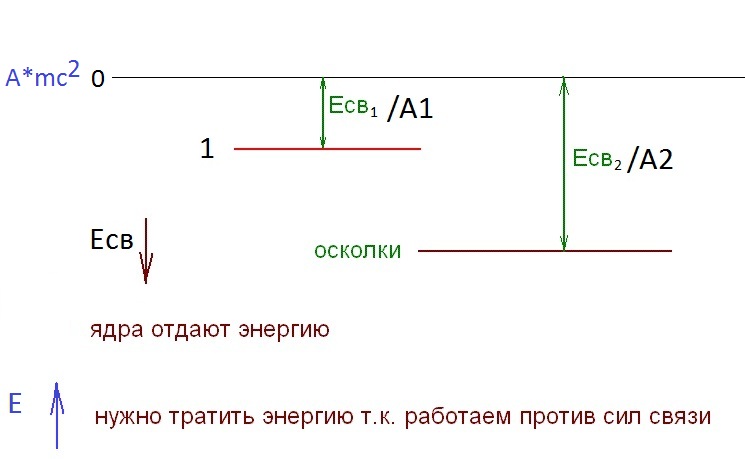
A2 = A1/2
The total binding energy of the fragments 2*(2E_b_2/A1)*A1/2 = 2E_b_2 is greater
than E_b_1, therefore upon fission into more strongly bound nuclei
energy is released.
Article author: Andrei Olegovich
