Nuclear shells
It seems I will still need time to rethink the
shells, because at the time I was badly confused, then Kolya
enlightened us, but I am still not sure my views are right
Let me remind you of the names of the quantum numbers (as I understand it there can be confusion here):
n is the principal quantum number
N also seems to be the principal quantum number, let us call it the oscillator one
L is the orbital moment (I use a capital letter because the lower-case one cannot be told from 1)
s is the spin
j is the total angular momentum
The relations between them and their values:
j = L + s
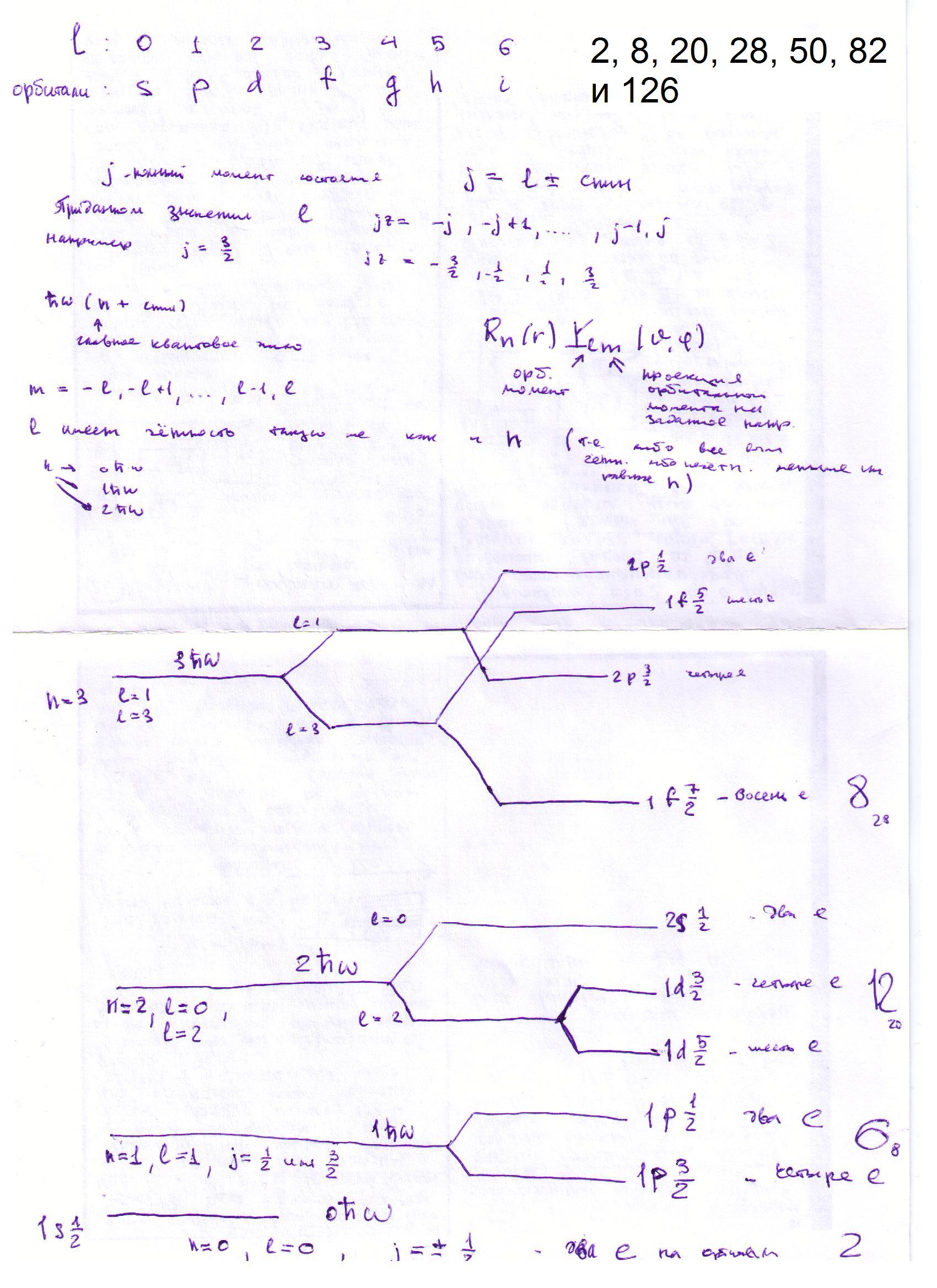
L = all numbers from 0 to N with the same parity as N.
s = + 1/2 or - 1/2
The complete scheme of the levels:
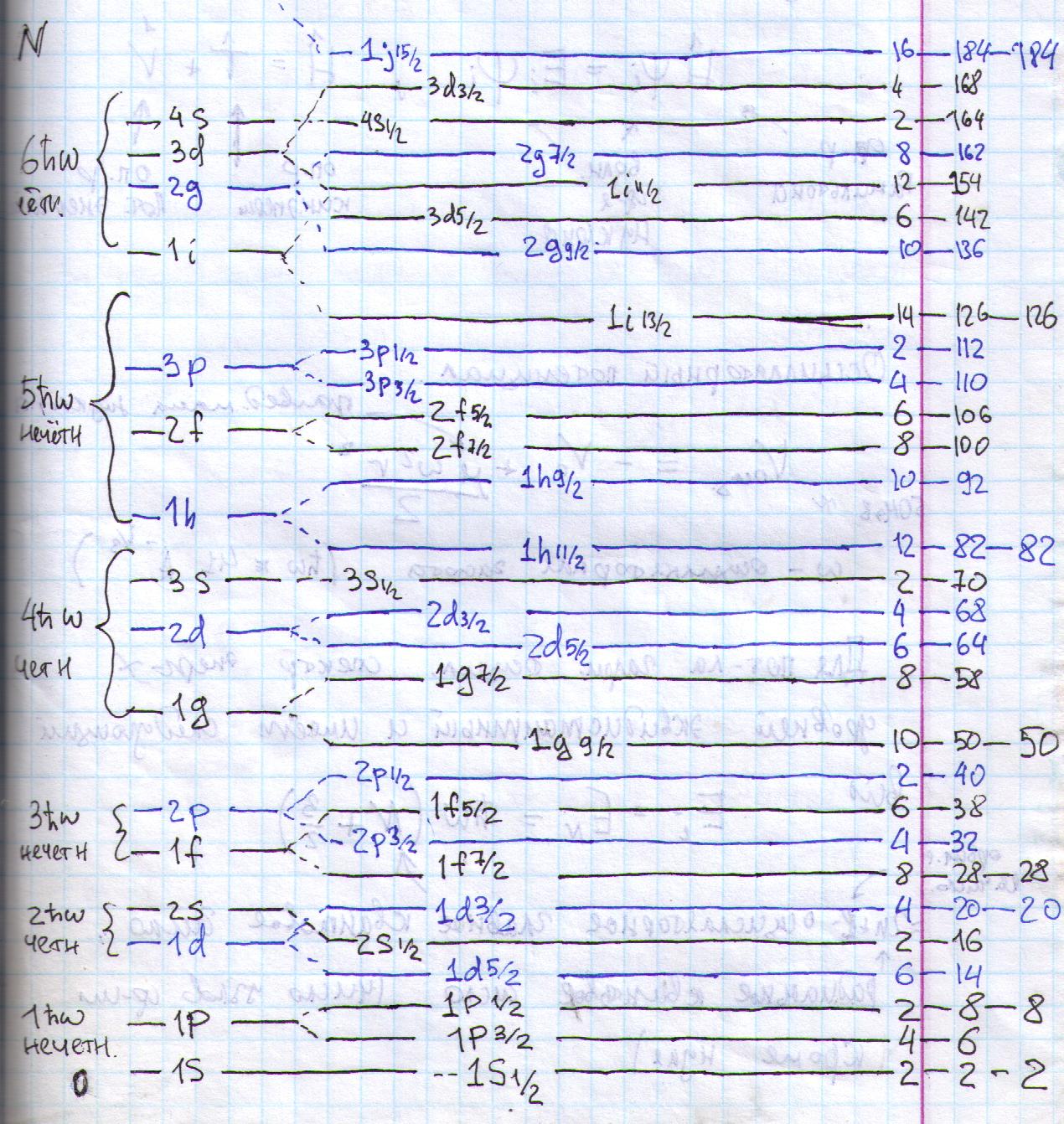
You have to pay attention to the level 1 g9/2 In fact it lies below the level 2 p1/2
so in the filled state there are already not 40 but 50 nucleons (by filled I mean the state where all the nucleons needed to fill the 2 p orbital are present 1/2)
The same situation with the level 11 h11/2, it goes below 3 s 1/2, and with the level 1 i13/2, which goes below 3 p1/2
I advise you to watch a video about what an orbital is and how to imagine it:
It is about atomic orbitals of electrons, but I suspect that the idea of nucleon orbitals differs only in the specifics of the interaction
From the first video you can understand that in the simplest case of a hydrogen atom the electron jumps over a sphere.
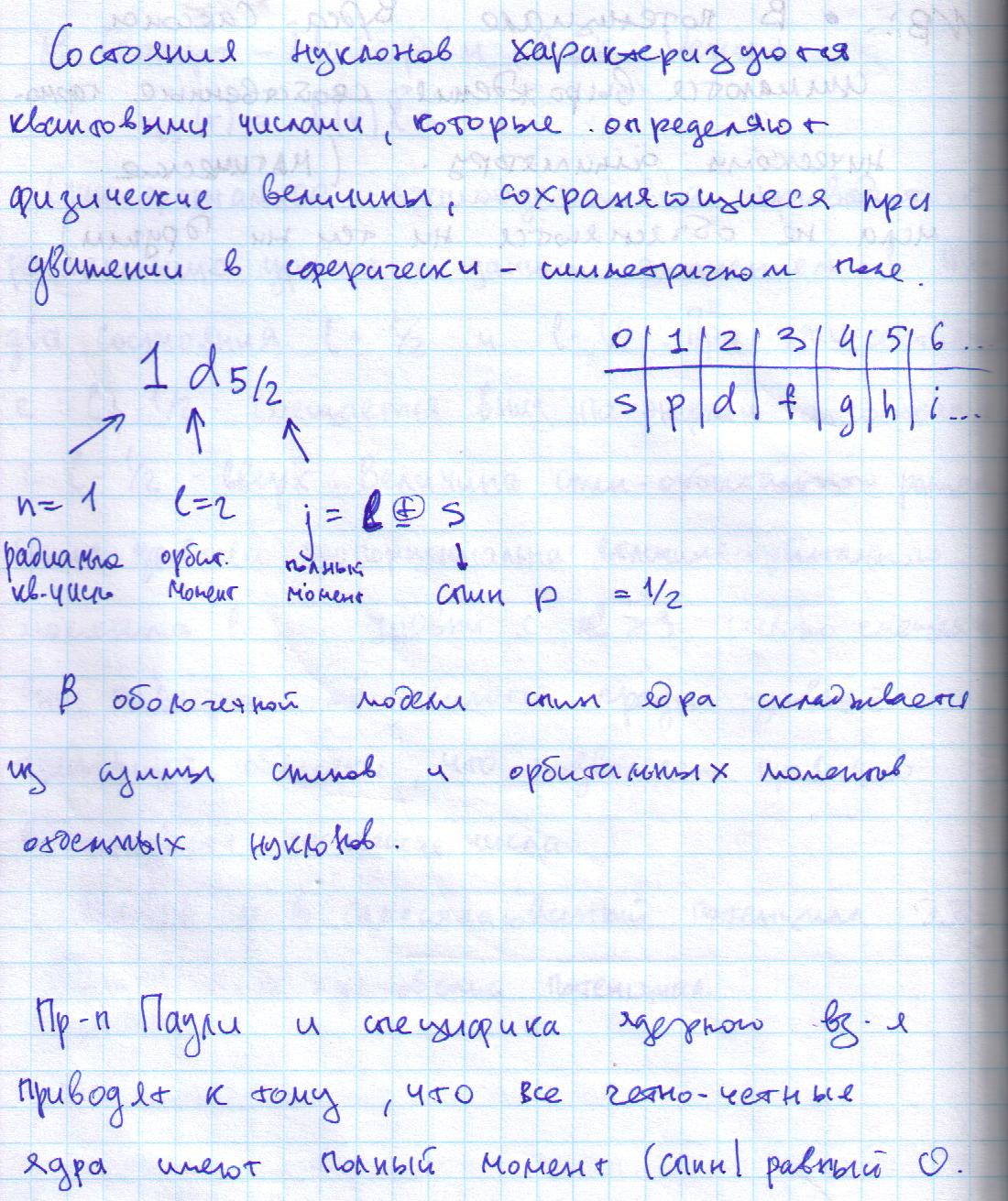
The first number in the notation of orbitals, for example 1 in 1 d5/2 corresponds to the oscillator model. I will not yet undertake to explain the meaning of this phrase.
n is the principal quantum number (it numbers the one-particle orbits with the same Lj in order of increasing energy) - source
Where j is the total angular momentum of the nucleon, equal to the sum of the orbital L and the spin s angular momenta: j = L + s (these are all vectors, do not forget the arrows).
L is the orbital moment, that is the vector product of the radius vector r and the momentum p
Let us try to get into the meaning of the phrase "it numbers the one-particle orbits with the same lj".
Consider n = 1: L = 1, j = 3/2 or 1/2; obviously the product lj is different here. I will have to write a letter; maybe at nuclphys.sinp.msu.ru they will explain the point to me.
After 1 comes the letter d, which means that the orbital moment is 2.
Table of correspondence:
| L | 0 | 1 | 2 | 3 | 4 | 5 | 6 |
| letters: | s | p | d | f | g | h | then alphabetically |
Some explanations for the numbers:
Article author: Andrei Olegovich