Preparing for the Unified State Exam in Physics
Write in the comments which other problem you would like to see solved.
How many neutrons the nucleus contains
Let us look at an example.
A polonium atom 21284Po contains 84 protons. This is immediately visible from the subscript.
It also contains 128 neutrons.
How did I find that out - I simply subtracted 84 from 212.
212 - 84 = 128.
A 17
Problem statement:
A boron atom 85B contains:
Answer options
1) 8 protons 5 neutrons and 13 electrons
2) 8 protons 13 neutrons and 8 electrons
3) 5 protons 3 neutrons and 5 electrons
4) 5 protons, 8 neutrons and 13 electrons
How to solve
To solve such problems, you need to understand what atoms consist of.
1) The simplest fact, which is easy to remember: in neutral atoms the number of protons and electrons is the same.
That is, if the problem statement does not say that the atom has a charge (i.e. it is not a simple atom but an ion), we assume that there are as many electrons as protons.
2) The subscript is the number of protons.
3) The superscript is the sum of protons and neutrons
4) As additional information, you can keep in mind that in light nuclei there are fewer neutrons than protons; as the mass grows, the number of neutrons catches up with the number of protons, and in heavy nuclei there can be far more neutrons.
Example
A boron atom 85B contains:
1) 8 protons 5 neutrons and 13 electrons
2) 8 protons 13 neutrons and 8 electrons
3) 5 protons 3 neutrons and 5 electrons
4) 5 protons, 8 neutrons and 13 electrons
85B
The subscript is the number of protons (see point 2).
So the number of protons in this atom is 5
Nothing is said about the charge of the atom, so it is neutral.
Consequently, there are as many electrons as protons - there are five of them too.
This knowledge alone is enough to choose answer number 3.
To check, we see that 5 protons plus 3 neutrons makes 8. That is,
the superscript must equal 8. It checks out.
Answer: 3.
A 18
Problem statement:
A graph is given of the change in the number of nuclei of a radioactive
isotope in a test tube over time. The half-life of this isotope -
First let us state the problem and the solution without a specific graph. Then we will go through an example.
Answer options
1) 1 month 2) 2 months 3) 3 months 4) 4 months or any other time interval.
How to solve such problems in the general case
1) The half-life is the time during which the number of nuclei decreases by half.
2) We look at the graph. We look for the axis along which the number of nuclei is plotted.
3) We look for any convenient section in which the number has changed by half.
4) We mark two points - the first is the point at which the number is larger.
The second is the point at which the number of nuclei is half of that at the first.
5) We remember that every point of the graph has two coordinates: the number of nuclei and
time.
6) After we have marked the points, we look at which time values correspond to them.
7) We subtract the smaller time from the larger one - that is the half-life.
Note: it is quite possible that several convenient pairs of points can be chosen on the graph; if the graph is correct, the answer will not change.
How to solve this particular example
Problem statement: A graph is given of the change in the number of nuclei of a radioactive
isotope in a test tube over time. The half-life of this isotope -
1) 1 month 2) 2 months 3) 3 months 4) 4 months
Graph:
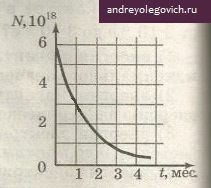
2) We look at the graph. We look for the axis along which the number of nuclei is plotted.
In our case this is the ordinate axis. It is underlined in orange.
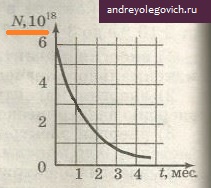
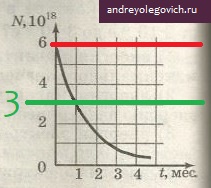
3) We look for any section in which the number has changed by half.
For example, let us choose the section in which the number of nuclei decreased
from 6 to 3.
To do this, let us draw two straight lines. The red one will correspond to the number 6 * N18
and the green one to 3 * N18
Now we need to find and mark the points at which these lines cross our graph.
Note:
If you are solving a problem not about radioactive decay but about something else,
there can be many such points - you need to choose two adjacent ones. In our case there will be only two of them.
4) We mark two points - the first is
the point, at which the number is larger.
The second is
the point, at which the number of nuclei is half of that at the first.
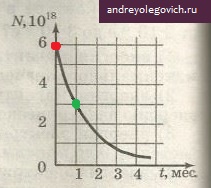
5) We remember that every point of the graph has two coordinates: the number of nuclei and
time.
6) After we have marked the points, we look at which time values correspond to them.
In our case these are 0 months and 1 month
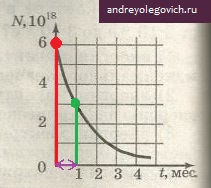
7) We subtract the smaller time from the larger one - that is the half-life.
1 month - 0 months = 1 month
Answer: 1 month

A 19
Problem statement:
Radioactive polonium 21684Po, having undergone one α-decay and two electron β-decays, turned into the isotope
Answer options
1) lead 21282Pb
2) polonium 21284Po
3) bismuth 21283Bi
4) thallium 20881Po
How to solve it without going into the essence at all
To put it quite simply: alpha decay subtracts 4 from
the superscript and 2 from the subscript. It adds nothing anywhere.
Electron beta decay does not touch the superscript but adds 1 to the subscript.
The letter depends on the subscript; if the subscript has not changed, the element has remained itself and the letter will not change.
216 - 4 = 212
84 - 2 + 1*2 = 84
Getting to the essence of what is happening
1) An alpha particle is two protons
together with two neutrons.
That is, the total number of particles (hadrons) is four.
It can be written with the following formula 42α2
2) α-decay: alpha decay is a process in which an alpha particle flies out of the nucleus.
That is,
the nucleus has two protons and two neutrons fewer.
3) The subscript is the number of protons in the nucleus.
21684Po, that is,
in our nucleus there are 84 protons
4) The superscript is the sum of protons and neutrons in the nucleus.
21684Po in our nucleus there are
84 protons and, consequently, 216 - 84 = 132 neutrons.
5) One α-decay means minus 4 from the superscript and minus 2 from the subscript.
6) electron β-decay or β- decay is a process in which a neutron turns
into a proton and emits another pair of particles that
do not remain in the nucleus.
7) β- decay does not change the superscript but increases the subscript by 1
Solving our example
21684 minus an alpha particle is 21282
that is, this is lead
21282Pb
Two electron beta decays increase the subscript by 2.
We get
21284 and this is polonium 21284Po
Article author: Andrei Olegovich
